
uplift
here are some uplifting words for the new year drawn from 9 episodes of conscient podcast et 3 extraits du balado conscient

Note: This posting was designed as an audio listening experience though, of course, it also exists in this written form. I invite you to click HERE to listen to it as an episode on conscient podcast. The same bilingual episode is also available on balado conscient.
It’s new years day, January 1, 2026, 8.51 am.
I want to start the narration of this posting of a calm presence by reading to you an Indigenous Land Acknowledgement statement that was developed by members of the Algonquin community for my former employer the Canada Council for the Arts. I have adapted slightly to make it my own.
I acknowledge that my studio, located in Ottawa, is on the unceded, unsurrendered Territory of the Anishinaabe Algonquin Nation whose presence here reaches back to time immemorial.
I recognize the Algonquins as the customary keepers and defenders of the Ottawa River Watershed and its tributaries. I honour their long history of welcoming many Nations to this beautiful territory and uphold and uplift the voice and values of our Host Nation.
Further, I offer my respect and affirm the inherent and Treaty Rights of all Indigenous Peoples across this land and honour commitments to self-determination and sovereignty that have been made to Indigenous Nations and Peoples.
I acknowledge the historical oppression of lands, cultures and the original Peoples in what we now know as Canada and fervently believe the Arts contribute to the healing and decolonizing journey we all share together.
Thanks to the Canada Council for the Arts for making the statement available and to the indigenous leaders who wrote it.
And, of course, these words are meaningless unless they are enacted in day to day life.
Welcome to a calm presence.
For those reading or listening for the first time I describe this Substack as ‘short essays for those in need of a calm presence : exploring collapse, revitalisation, spirituality, art…’
However, sometimes, on special occasions, I publish longer postings, like this one.
You’ll notice that the pace of my narration is rather slow with the occasional short silence. This is how I like to listen to narrations, with lots of space to ponder what is being said but also to consider what might lie in between the words and in the timbre of the voice.
I’m also recording this reading in one take, flubs and all, similar to a live late night radio monologue where it’s ok to be imperfect because it’s real and where time is suspended.
Here we go…
When I produce conscient podcast or balado conscient episodes, I usually insert a short excerpt from my conversation at the top of the show as a sample of what is to come.
I also use this excerpt in the promotion of episodes on social media through video clips that include a transcription of the text. And I’ve heard from some people that this teaser is the only point of contact they have with an episode. Everyone is so saturated with media that they might never hear the full episode, so I try to select really good excerpts, where the voice of my guest has a particular tone, spirit and energy.
Sometimes I’m attracted to the vulnerability in their voice. Sometimes it’s their courage that comes through or their spirit of defiance. Sometimes it’s simply the way they ask a question, or maybe the way a moment of silence lingers. Sometimes it’s a very slight hesitation or boisterous moment of joy.
And it’s this combination of timbre and content that uplifts my spirits every time I hear one of those quotes. Those few words have a way of making me feel… hopeful again or at least not as isolated or anxious.
So, you’re about to hear 9 excerpts in English from conscient podcast et 3 extraits en français tiré du balado conscient.
Afin de faciliter la compréhension des extraits en anglais, j’ai ajouté une transcription de l’épisode en français dans les notes d’épisode. J’ai aussi ajouté un petit sommaire oral en français à la fin de chacun des épisodes en anglais. Personnellement, je trouve intéressant d’écouter quelqu’un parler dans une autre langue, car je peux me concentrer sur le ton et l’intonation de la voix.
And for those who do not understand French I have added a transcript in English in the episode notes. I also created a short English language oral summary for each of the French language episodes. Personally, I find it interesting to listen to someone speak in another language because I can focus on the tone and inflection of the voice.
Now, before we start, some of you might recall that I changed the format of a calm presence in November of 2025.
While hiking in the Andes Mountains in Ecuador last October, for some reason, I kept thinking about Tibetan sand mandalas. Why Tibetan sand mandalas in the Andes, I’m not sure but there it was.
I think I was curious to know how it feels to wipe away one’s work once it is done and it might mean to let the spirit of one’s work return to the earth once a message has been shared. Something like that. So I looked up sand mandalas on Wikipedia:
The creation and destruction of mandalas made from colored sand. Once complete, the sand mandala’s ritualistic dismantling is accompanied by ceremonies and viewings to symbolize Buddhist doctrinal belief in the transitory nature of material life.
So my enactment of a transition of material life led me to remove all 81 previous postings of a calm presence Substack and to start anew.
I now publish one posting at a time, for a few weeks and then replace it with a new one and so on. In other words, what you’re listening to now, recorded on December 30th 2025 will be erased in February 2026, never to be published again but I hope might be retained in the memory of those who might need it, which is why I created this Substack in the first place.
And in this case you’re about to benefit from the calming presence of 17 artists, cultural workers and diplomats whom I quote in this episode: Alison Tickell, Claudia Salguero, Chantal Dumas, Yin Paradies, Jen Rae, Antonia Leney-Granger, Monique Savoie, Jimmy Ung, Alexis Curodeau-Codère, Louise Poulin, Lallan, France Trépanier, Geneviève Tuts, Akash Rastogi, Juan Erazo, Jennifer Abbott and Hildegard Westerkamp.
One more thing before we jump in, please join me in observing a minute of silence, wherever you are and for whichever cause or issue you may wish.
1
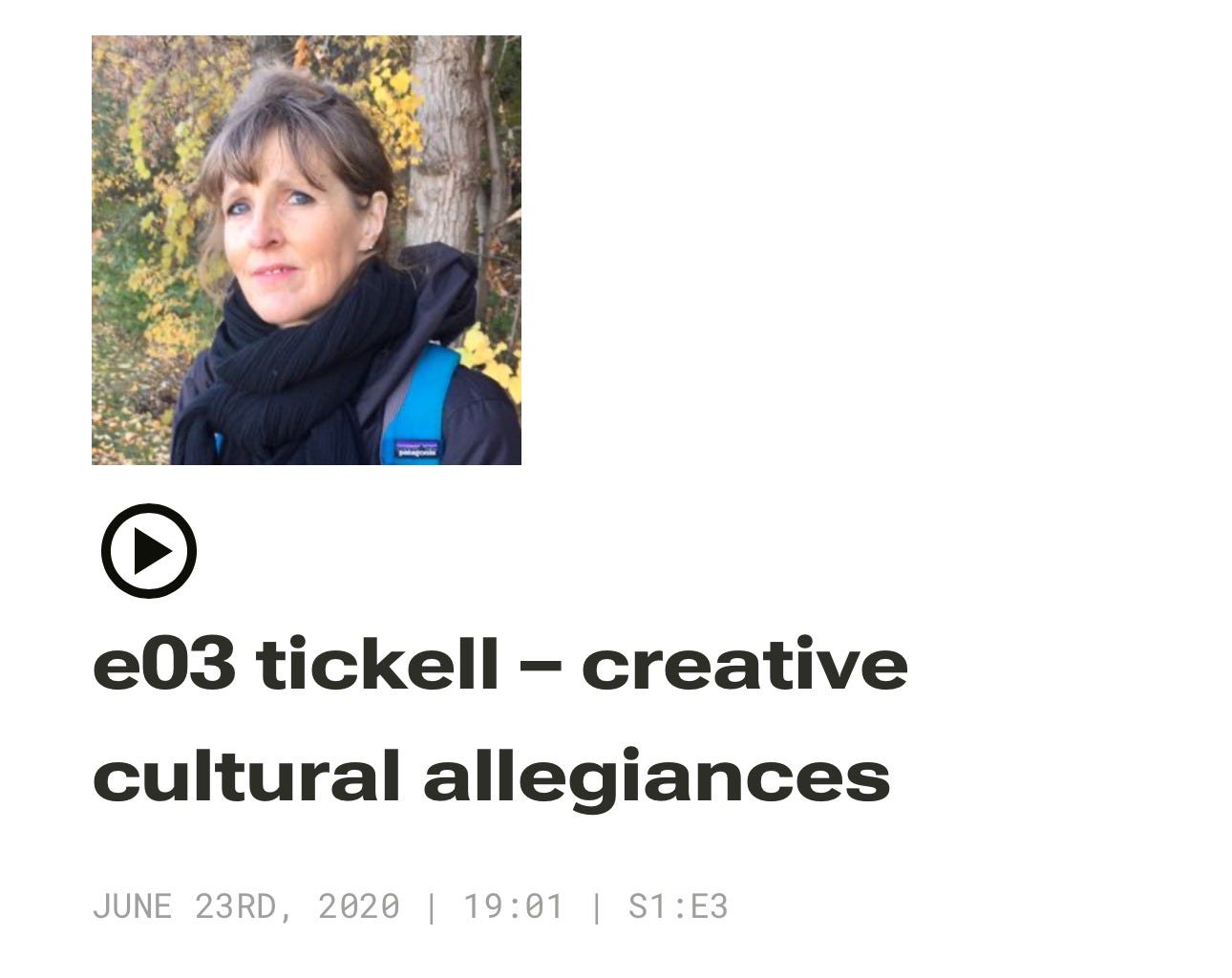
Art can speak to people in meaningful ways that really does call on us to respond to this differently. So, wherever you are, anywhere in the world, you will almost certainly have some kind of creative cultural allegiance and how do we use that in a purposeful way is a critical question for us all…
This one is close to my heart. This excerpt is from e03 alison tickell – creative cultural allegiances, recorded on October 20, 2019 while Alison and I were walking on Parliament Hill in Ottawa, from Wellington street down to the Ottawa River. This was my first conversation for conscient podcast and one that continues to resonate.
What uplifts me here is the vitality and determination in Alison’s voice. Alison, as you might know, is a force of nature as leader of Julie’s Bicycle in the UK.
I love the way she reminds us about the untapped power of the arts in the fight against climate change and how our allegiance with the earth - indeed our love of the earth - is critical.
2019 seems so long ago. I was still in my 50’s. Some of you might recall that the fall of 2019 was a very hopeful time in the world. The COVID pandemic had not yet begun and there were massive climate protests and actions all around the world. We need to regain this momentum in 2026.
J’aime la façon dont Alison Tickell nous rappelle le pouvoir inexploité des arts dans la lutte contre le changement climatique et à quel point notre allégeance à la Terre, voir notre amour pour la Terre, est essentielle.
2
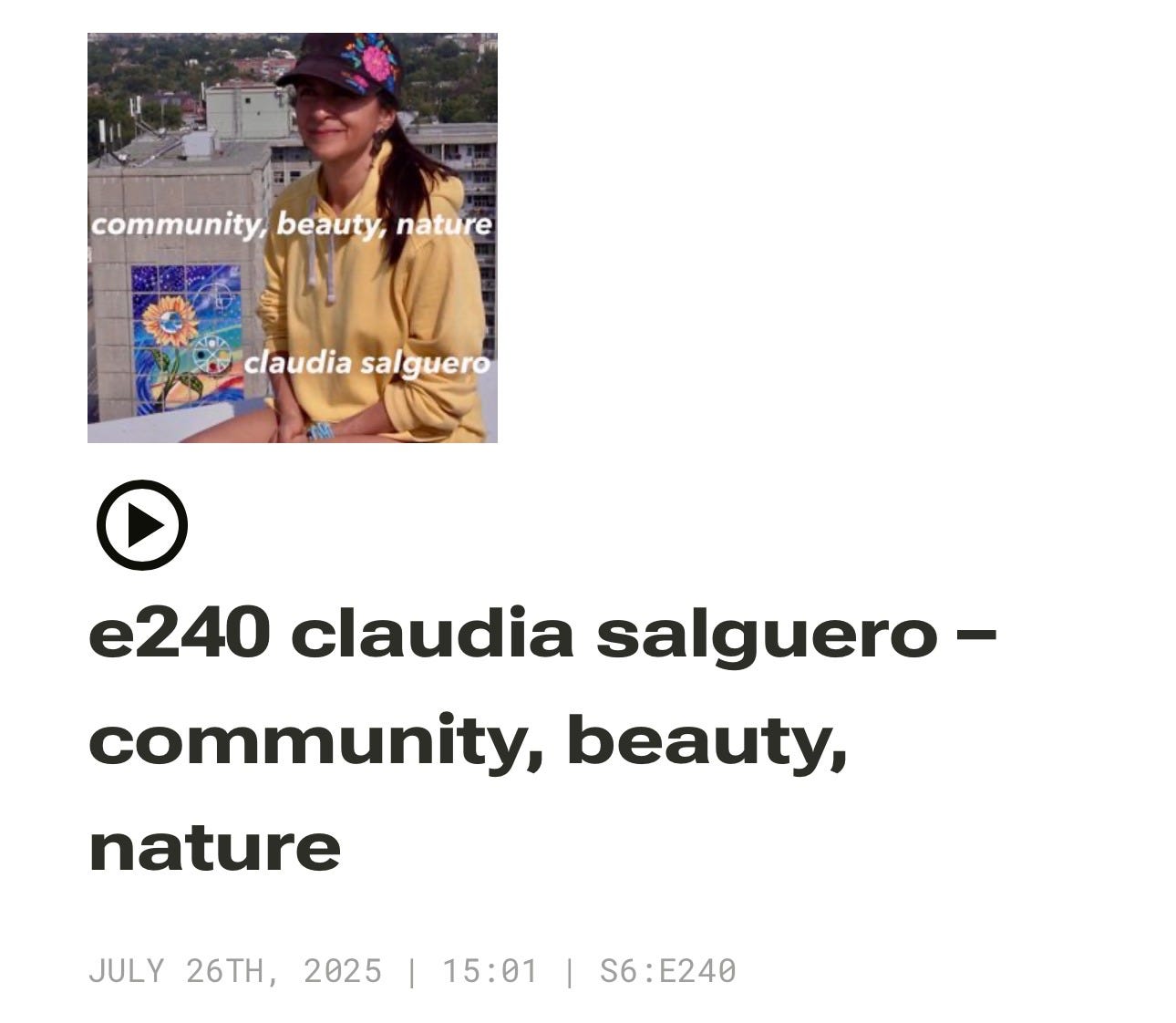
To me, there’s three key things and it’s community, beauty and nature. I think if we connect with nature and if we produce beauty, that is something that we as humans think is our biggest gift. And I’m not just talking about creating art : speaking beauty, listening to beauty, creating beauty, opening our hearts to beauty in community. Because if we don’t have a sense of the other in ourselves, then we’re lost, we cannot do it alone. And this has been proved forever. But I think if we have these three things, to me, as the kind of person I am, we have it all. We’re connected with nature, understanding that we are nature, we are part, we are one with nature and we are interacting with other human beings. And we create beauty and we are inspired by beauty. It would be a completely different world. And that to me is like the mission of the arts.
This excerpt is from e240 claudia salguero – community, beauty, nature and was recorded on July 8, 2025 at my home in Ottawa.
Claudia is a Colombian Canadian community engaged artist based in Ottawa, who is known for her vibrant and expressive public murals and her excellence in collaborative art.
I was inspired by the energy in Claudia’s voice when she talks about the interconnectedness of community, beauty and nature. If you listen to the complete 15 minute conversation you’ll hear her describe her Wisdom Mural project which is inspired by the teachings of Ottawa based knowledge keepers.
This episode is one in a series about the community-engaged arts for social change, which I think will be increasingly important as we as the world turns to bio-regional governance and community self-sufficiency.
J’ai été inspirée par l’énergie dans la voix de Claudia lorsqu’elle parle de l’interdépendance entre la communauté, la beauté et la nature. Cet épisode fait partie d’une série consacrée aux arts communautaires engagés en faveur du changement social, qui, selon moi, vont prendre de plus en plus d’importance à mesure que le monde s’oriente vers une gouvernance bio régionale et l’autosuffisance communautaire.
3
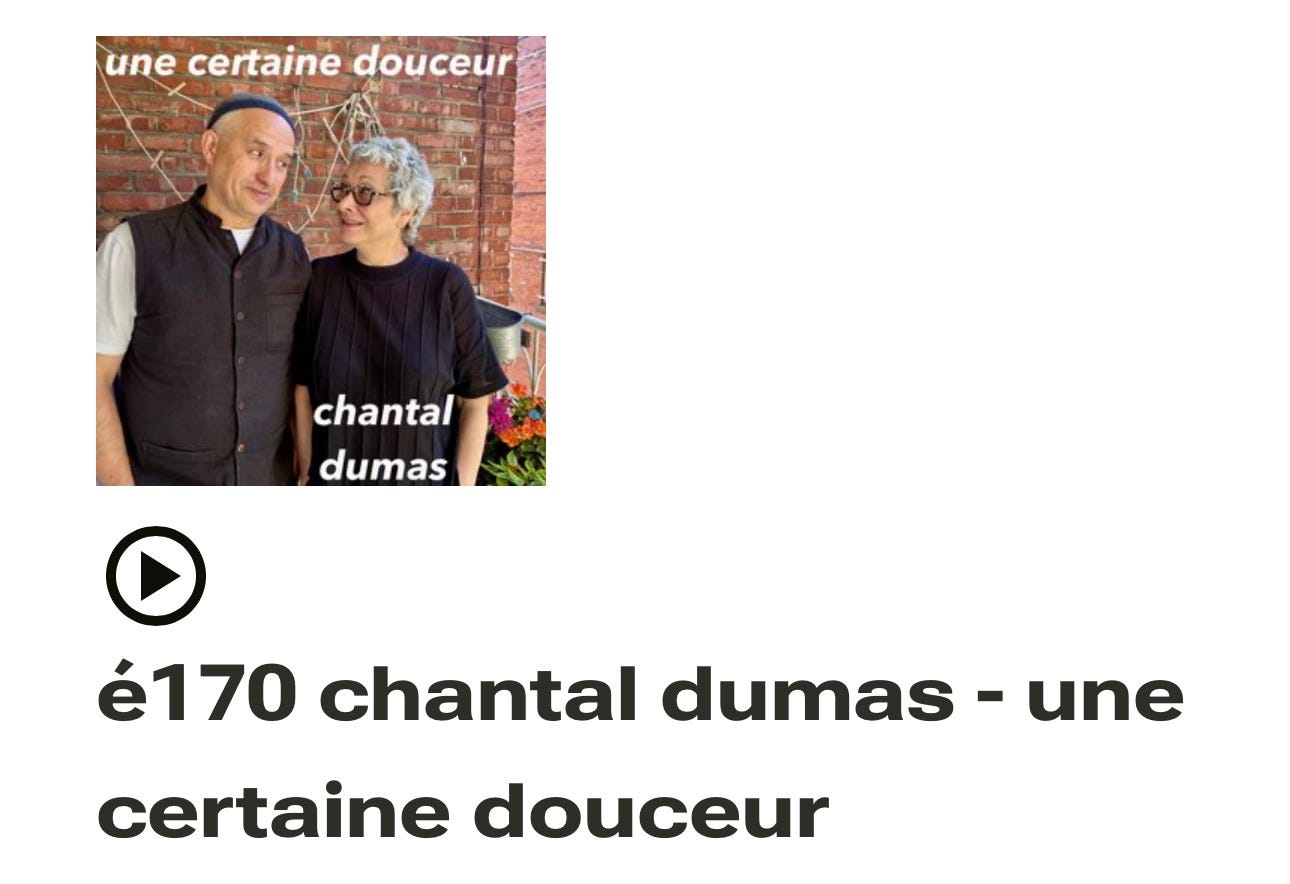
Pour moi, le climat mondial, l’état des choses, ça appelle à se ramener à des échelles beaucoup plus petites, à des échelles de communautés, je dirais, de communautés d’intérêt, de communautés de sensibilité, puis de se rapprocher des nôtres, les nôtres étant la famille immédiate, mais qui sont aussi les amis, et de chérir vraiment cet aspect-là, tout en restant sensible à ce qui se passe autour de nous. Mais de trouver une façon de - je ne sais pas si j’appellerais ça de la consolation - mais en tout cas d’avoir une certaine douceur. Je pense que l’art peut apporter ça pour calmer l’anxiété.
Ceci est un extrait de é170 chantal dumas - une certaine douceur enregistré à Montréal le 21 novembre 2025 avec l’artiste sonore et une amie de longue date, Chantal Dumas qui m’a parlé, entre autre, de sa composition électroacoustique « Oscillations planétaires » une oeuvre qui nous invite à imaginer que nous écoutons les battements du cœur de la Terre, que nous sentions le grondement des plaques tectoniques et que vous vivons dans un temps géologique.
Dans cet extrait de notre conversation, Chantal nous invite à approfondir nos relations intimes et de se laisser consoler par l’art afin de calmer nos anxiétés et notre angoisse et de retrouver une certaine douceur dans nos relations avec la terre, j’aime beaucoup cette phrase, une certaine douceur, c’est très, comment dire … Chantal Dumas.
In this excerpt, sound artist Chantal Dumas invites us to deepen our intimate relationships and to allow art to calm our anxieties and grief with a view to rediscovering a certain gentleness - une certain douceur - in our relationship with the earth.
4
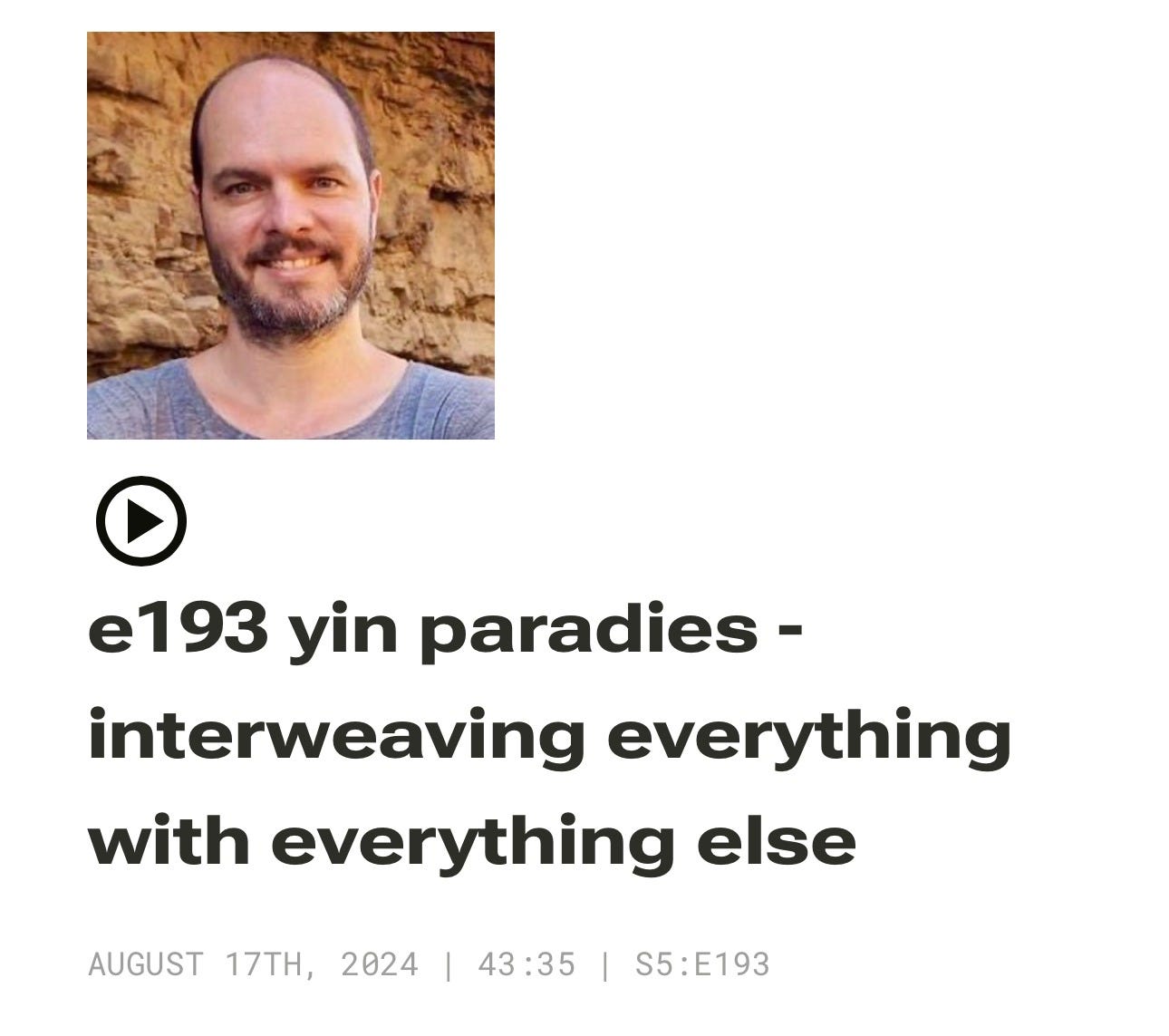
In primal cultures, there’s a tendency to interweave everything with everything else, including art. People are very creative and expressive in everyday life, through ceremony and ritual, dance and art and carving and weaving and various aspects of life that are just considered quite normal for primal peoples. Part of primal cultures is a strong engagement with and resonance with eccentricity and uniqueness so people do things, even hunting, is an art form that people do in different ways.
This excerpt is from e193 yin paradies - interweaving everything with everything else recorded on July 9, 2024 by Zoom from Yin’s home in Australia. Yin Paradies is a Wakaya anarchist radical scholar spreading decolonial love from, and as part of, unceded Wurundjeri land.
Yin is also a climate and ecological activist committed to understanding and interrupting the devastating impacts of modern societies who seeks meaningful mutuality of becoming and embodied kinship with all life through transformed ways of knowing, being, and doing that are grounded in wisdom, humility, respect, and generosity.
During our conversation I asked Yin what artists and cultural workers might want to know about ‘how humans lived before modern societies’? His responses were illuminating and literally slowed me down my metabolism as our conversation unfolded.
I love what yin says about art as life but also because every time I listen to the recording his voice calms me down once again and helps me become more mindful and reminds me that we are nature.
J’aime ce que Yin dit à propos de l’art comme étant la vie, mais aussi parce qu’à chaque fois que j’écoute l’enregistrement, sa voix m’apaise à nouveau et m’aide à être plus attentif au moment présent et au fait que nous sommes la nature.
5
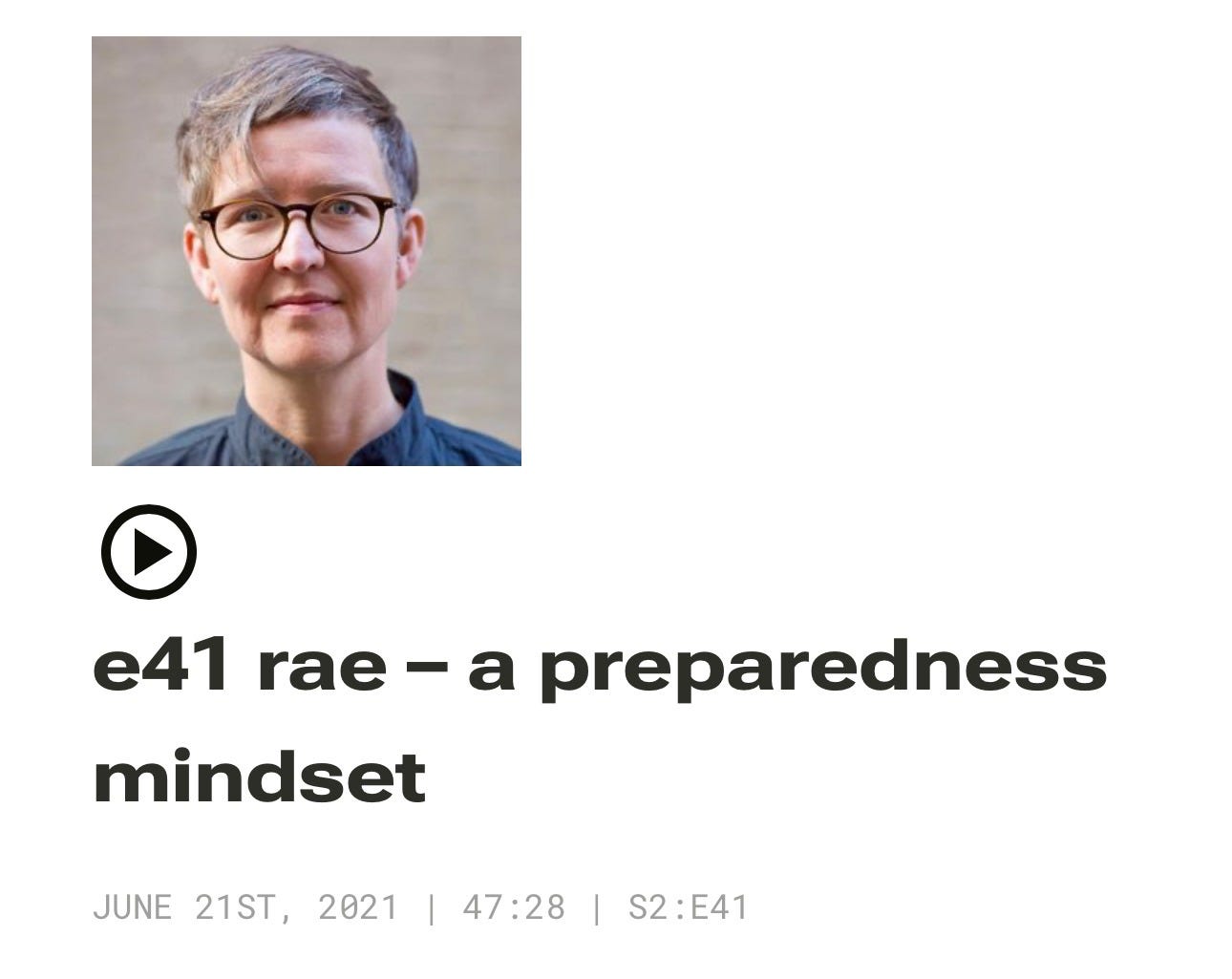
The thing about a preparedness mindset is that you are thinking into the future and so if one of those scenarios happens, you’ve already mentally prepared in some sort of way for it, so you’re not dealing with the shock. That’s a place as an artist that I feel has a lot of potential for engagement and for communication and bringing audiences along. When you’re talking about realities, accepting that reality has the potential to push us to do other things. It’s great to hear about the Canada Council changing different ways around enabling the arts and building capacity in the arts in the context of the climate emergency. It’ll be interesting to see how artists step up.
Emergency preparedness is on my mind these days so I often turn to Jen Rae’s work for inspiration and insight. This excerpt is from my May 10, 2021 conversation from e41 rae - a preparedness mindset with Jen who is a Narrm (Melbourne)-based artist-researcher, facilitator and educator of Canadian Red River Métis-Scottish descent from Treaty 6 Territory.
Jen’s practice-led research expertise is in the discursive field of contemporary environmental art and environmental communication and is centred around cultural responses to climate change/everything change - specifically the role of artists and creative inquiry.
I like the way Jen invites us to develop a preparedness mindset in order to avoid being shocked by the consequences of modernity. I also like the way Jen reminds us that acceptance leads to action.
J’aime la façon dont Jen nous invite à développer un état d’esprit préparé afin d’éviter les chocs et d’être prêts, tant physiquement que mentalement, à faire face aux conséquences de la modernité. Cela me semble prémonitoire et représente un juste milieu entre le déni et la panique. J’aime également la façon dont Jen nous rappelle que l’acceptation peut mener à l’action.
6
C’est comme le narratif est juste autour des choses qu’on va devoir enlever de nos vies. On ne parle jamais des choses qu’on va gagner, qu’on va reprendre le contrôle, ce qu’on va avoir de plus. (Antonia Leney-Granger)
Pour moi, l’abondance, c’est la connexion, la relation avec la source. Quand on est en relation avec la source, la source de la vie, on est en abondance. (Jimmy Ung)
Le plaisir de se lever le matin en se demandant pas ce qu’on va faire, mais en se demandant qu’est-ce qu’on a envie de faire. Changer la question, changer comment on se parle à nous-mêmes, comment on aborde cette ouverture. Puis je pense que c’est le temps de parler de l’abondance comme on l’entend. (Monique Savoie)
L’abondance existe si j’ai de la gratitude. Si je suis capable de dire j’ai au lieu de je veux, est-elle là l’abondance. (Louise Poulin)
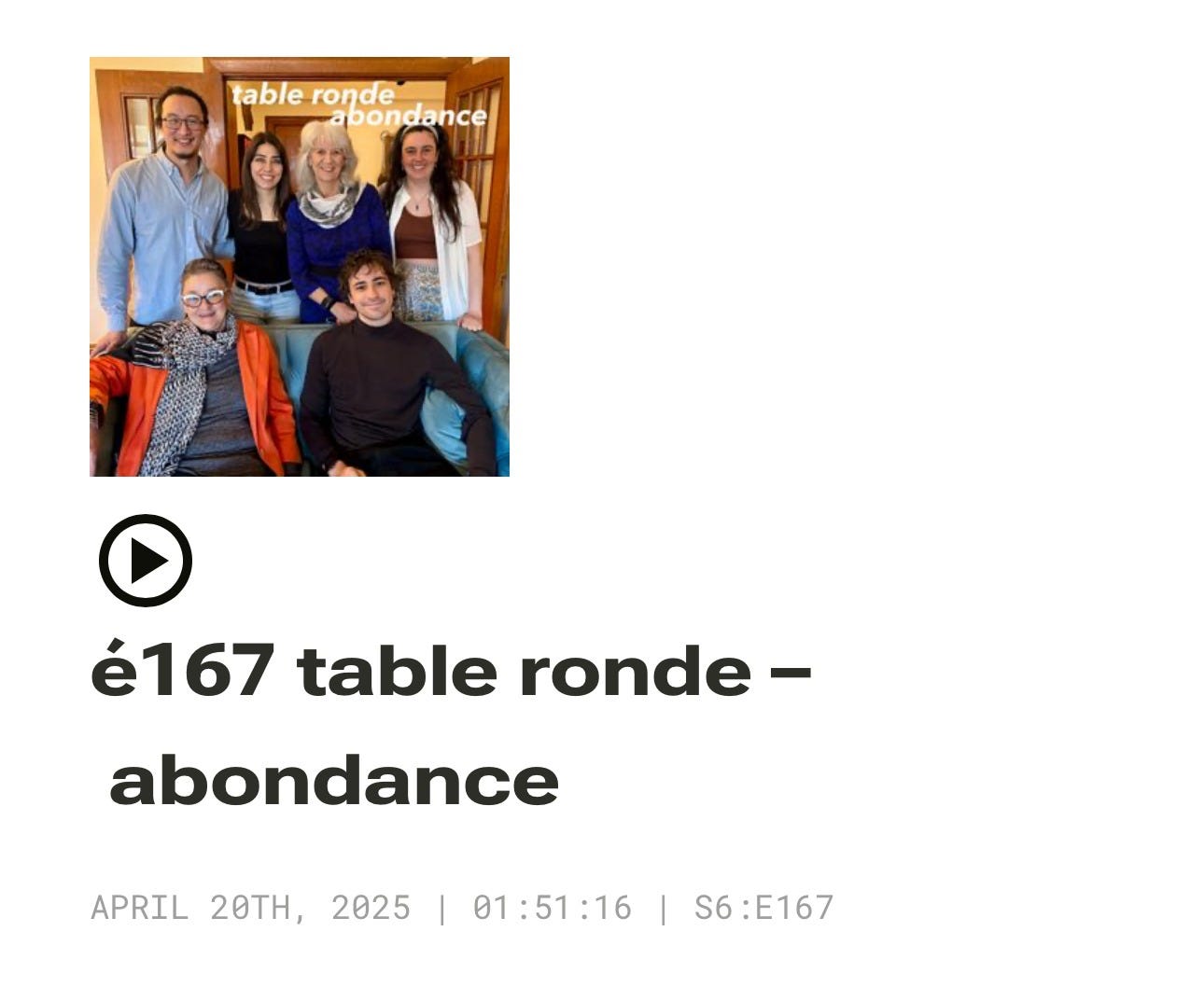
Ces 4 extraits proviennent de la première table ronde du balado conscient, é167 table ronde – abondance, enregistrée le 13 avril 2025 à Montréal avec Monique Savoie, Jimmy Ung, Rasha Masalkhi, Antonia Leney-Granger, Alexis Curodeau-Codère, Louise Poulin et moi-même.
Les tables rondes du balado conscient sont des discussions informelles de longue durée avec des amis et des collègues afin d’explorer leurs passions, leurs craintes et leurs rêves. Nous avons surtout parlé d’abondance lors de cette session de 111 minutes : abondance dans le sens de notre relation avec la source de la vie, avec ce qui est renouvelable, avec simplicité et gratitude.
This group of seven artists and culture workers in Montreal talked about abundance, in the sense of our relationship with the source of life, with what is renewable, with simplicity, and of gratitude.
7
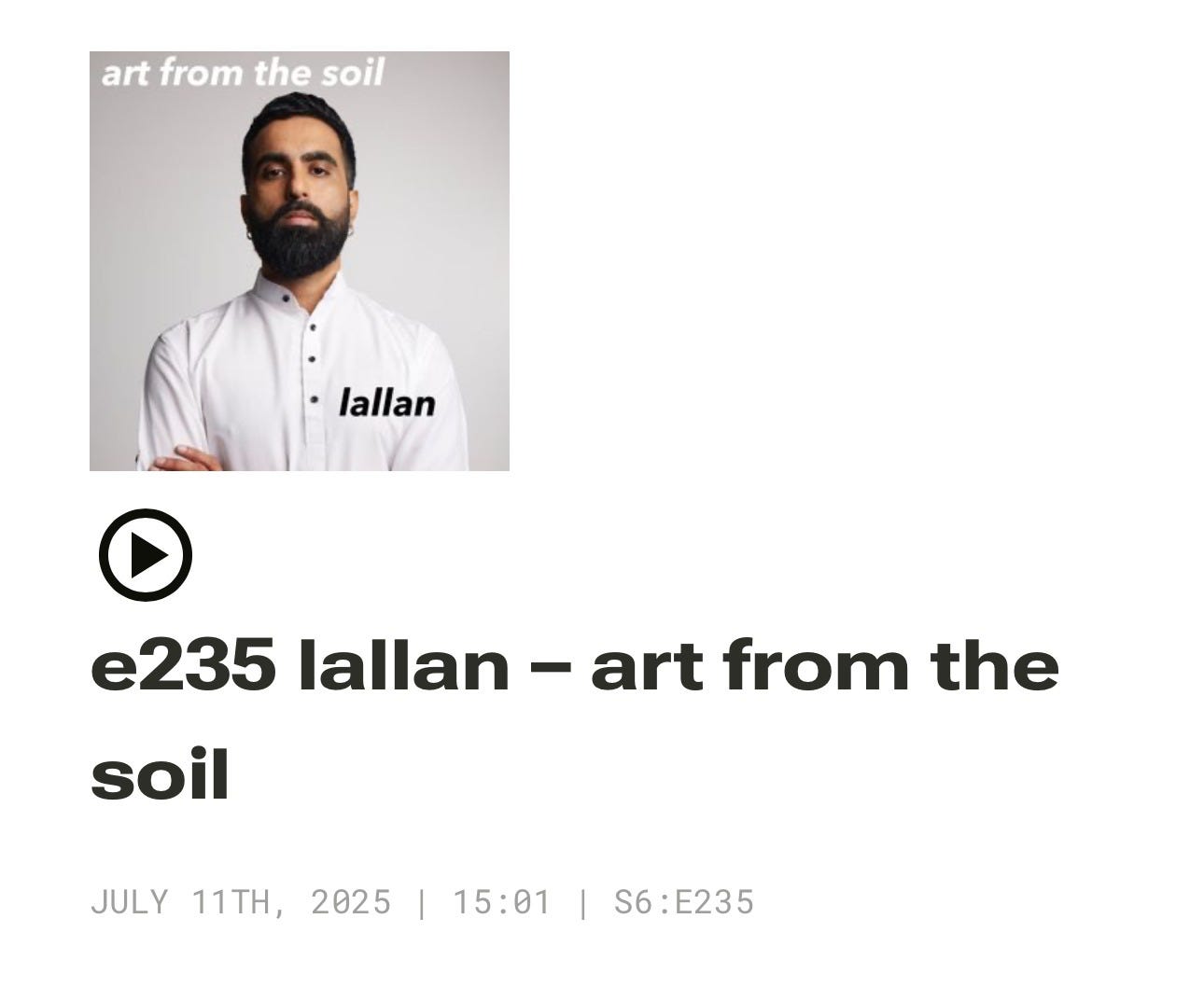
My advice to artists would be drop every garb that you have, drop every piece of knowledge that you think you have. Head to the jungles, head to the rural places. We are living in a time of crisis. We need artists more than scientists. We need artists more than the healers. We need artists more than anything because arts connects everybody. We need songs, we need stories, we need pictures, we need circles, we need Ubuntu to prosper. Traditional Western ways of colonized ways of working will not save us as a species. They’re not going to help us. They’re only going to destroy. And the traditional arts ecosystem exists like that everywhere in the world. Now we know that it’s been going on for hundreds of years. We need to destroy that as artists and we need to head to where our roots are, which is in the soil. And our arts come from there.
This is e235 lallan – art from the soil. I first met Lallan at the Sunshine Himalayan Cottage facility in the Tirthan Valley, Himachal Pradesh, India. Lallan on April 28th, 2925. Lallan is a multi-disciplinary and socially engaged artist whose practice is rooted in working with the earthen and on a lookout for the conditions which enable genuine co-authorship within communities.
We spoke near the Thirtan River, one of the last untouched natural rivers in northern India. You can hear a whisper of its rushing waters in the background as he speaks, the spirit of water and soil present in every word.
J’aime la façon dont Lallan nous invite à revenir à nos racines dans la terre pour redécouvrir qui nous sommes en tant qu’artistes et, par extension, que nous sommes tous des artistes.
8
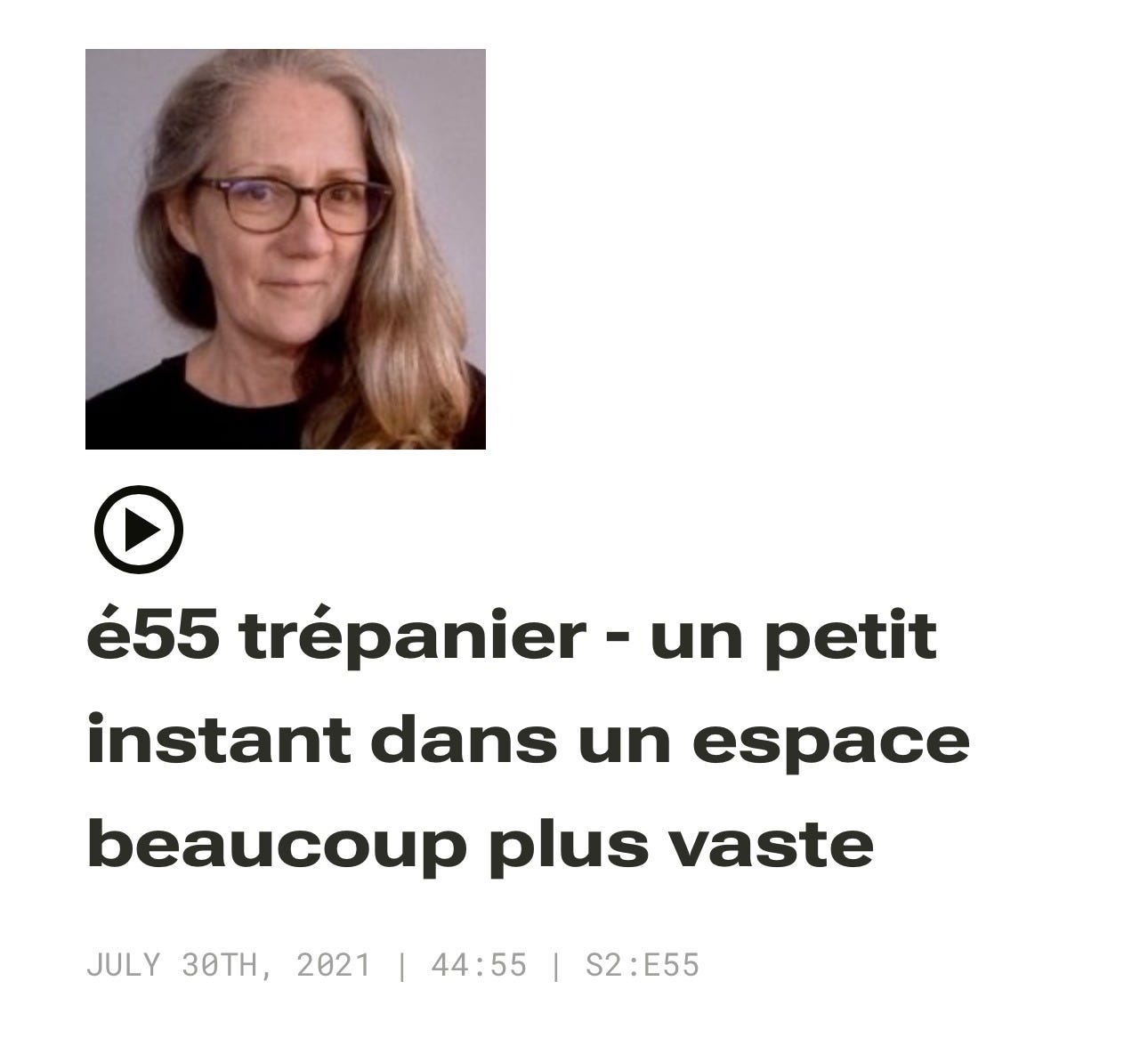
Je pense que ce cycle du colonialisme, et de ce que ça a apporté, on est en train d’arriver à la fin de ce cycle là aussi, et avec le recul, on va s’apercevoir que cela a été un tout petit instant dans un espace beaucoup plus vaste, et qu’on est en train de retourner à des connaissances très profondes. Qu’est-ce que ça veut dire de vivre ici sur cette planète? Ce que ça implique comme possibilité, mais comme responsabilité aussi de maintenir les relations harmonieuses? Moi, je dis que suis la solution à la crise climatique c’est cardiaque. Ça va passer par le cœur. On parle d’amour avec la planète. C’est ça, le travail.
Ma conversation avec l’artiste, la commissaire et chercheure d’ascendance Kanien’kéha:ka et française, France Trépanier, é55 trépanier - un petit instant dans un espace beaucoup plus vaste, enregistrée le 7 juin 2021 sur Zoom à partir de la maison de France à Sidney, en Colombie britannique. J’ai ensuite publié à nouveau cet épisode le 12 juillet 2025 dans le cadre de ma série ENCORE.
J’avoue que à chaque fois que j’écoute cet extrait ma perception du temps et de l’espace s’élargit et je devient plus léger et serein.
France nous parle de Terra nullius et comment cette rencontre avec les Européens sera un jour un tout petit instant dans l’histoire. France nous parle aussi de la tragédie du Canada dans le sens que les nouveaux venus n’ont jamais compris ni pu adopter les cultures d’ici et que cette grande mésentente persiste.
Son optimisme est en lien avec notre capacité de tomber amoureux de la planète.
France tells us about Terra nullius and how this encounter with Europeans will one day be just a tiny moment in history. France also tells us about the tragedy of Canada in the sense that the newcomers never understood or were able to adopt the cultures here, and that this great misunderstanding persists. His optimism is linked to our ability to fall in love with the planet.
9
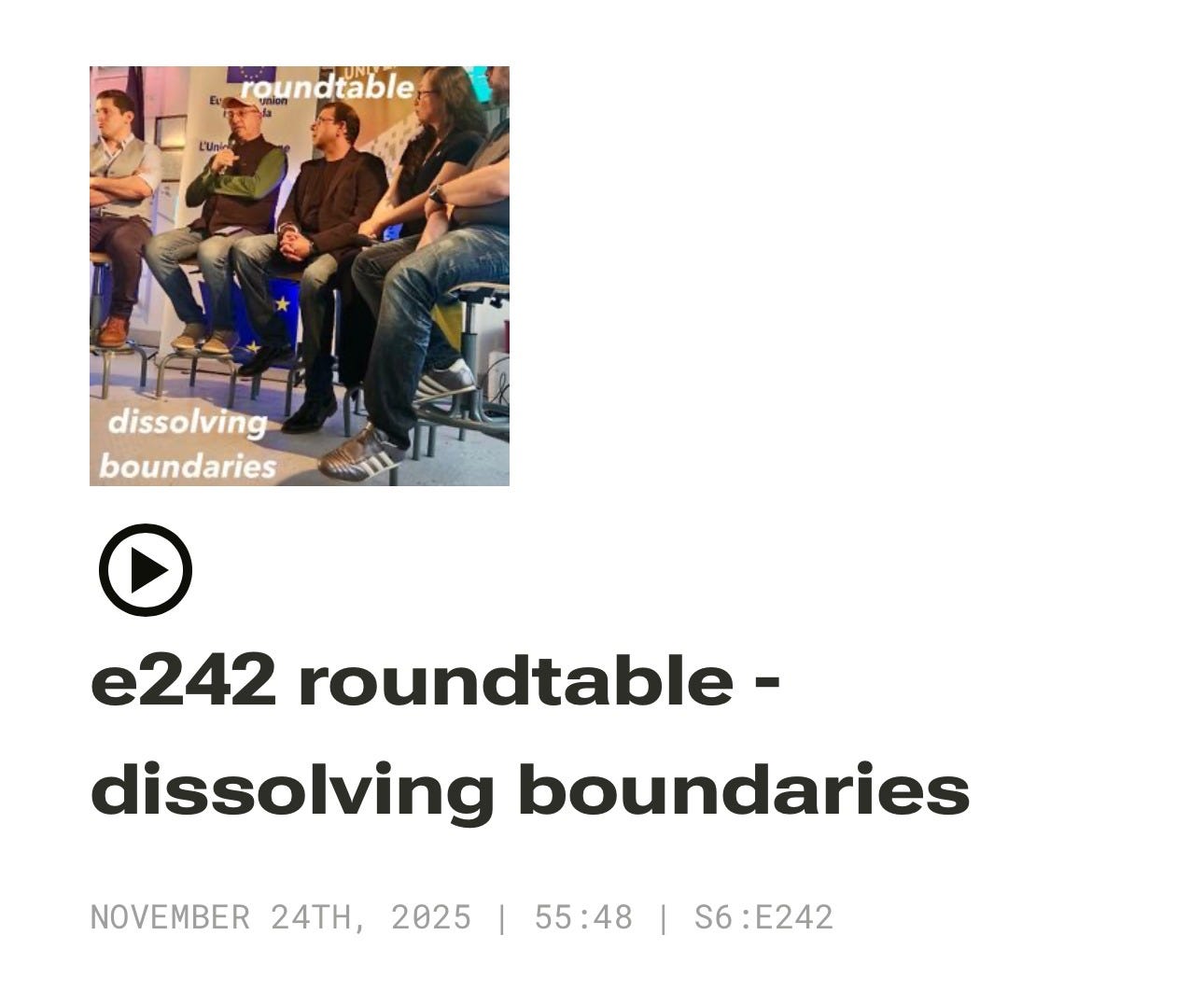
In an era where pressures on climate and environments grow even stronger, we should not underestimate the transformative power of art. (Ambassador of the European Union to Canada Geneviève Tuts)
When you do the trigger, the emotional part, you can go down hope and fear both. Both lead to action but ultimately, we need to transform being passive into really active contributors to solving this and what a better way than art? (Akash Rastogi, Chief Capital Strategy Officer at Canada’s Ocean Supercluster)
We want to activate the creativity of communities through the arts to create the cities of the future, basically, right, the cities we want to live in (Juan Eraso, leader of international programs at Culturans)
‘Change happens. There’s always going to be ways to adapt. That’s not to say that the initial change might not be catastrophic but there was always going to be something left and you have to work with that’. (from e208 clara schryer - science as story). Now it breaks my heart to hear that because for a young person to say that means that they don’t anticipate there won’t be a lot left and yet… we know that when we work with green spaces, we work with life, we work with art, we can rebuild, we can regenerate, but we have to do it differently. (Claude Schryer)
This compilation of voices is from e242 roundtable - dissolving boundaries, at a panel called Dissolving Boundaries that took place on October 4, 2025, as part of Nuit Blanche Toronto, co-presented by the Global Centre for Climate Action at OCAD University and the European Union (EU), through its Delegation to Canada.
I was uplifted by the Ambassador of the EU to Canada, Geneviève Tuts when she reminded us of the transformative power of art, by Akash Rastogi, the Chief Capital Strategy Officer at Canada’s Ocean Supercluster and his belief in how art can trigger an emotional response to complexity, by Juan Erazo of the Culturans organization in Mexico and his belief community arts can help us develop a vision of how we really want to live. My own contribution was about how art can help us rebuild and regenerate.
J’ai été inspirée par l’ambassadrice de l’Union européenne au Canada, Geneviève Tuts, lorsqu’elle nous a rappelé le pouvoir transformateur de l’art, par Akash Rastogi, directeur de la stratégie d’investissement chez Canada’s Ocean Supercluster, et sa conviction que l’art peut susciter une réponse émotionnelle à la complexité, ainsi que par Juan Erazo, de l’organisation Culturans au Mexique, et sa conviction que les arts communautaires peuvent nous aider à développer une vision de la façon dont nous voulons vraiment vivre. Ma propre contribution portait sur la manière dont l’art peut nous aider à reconstruire et à régénérer.
10
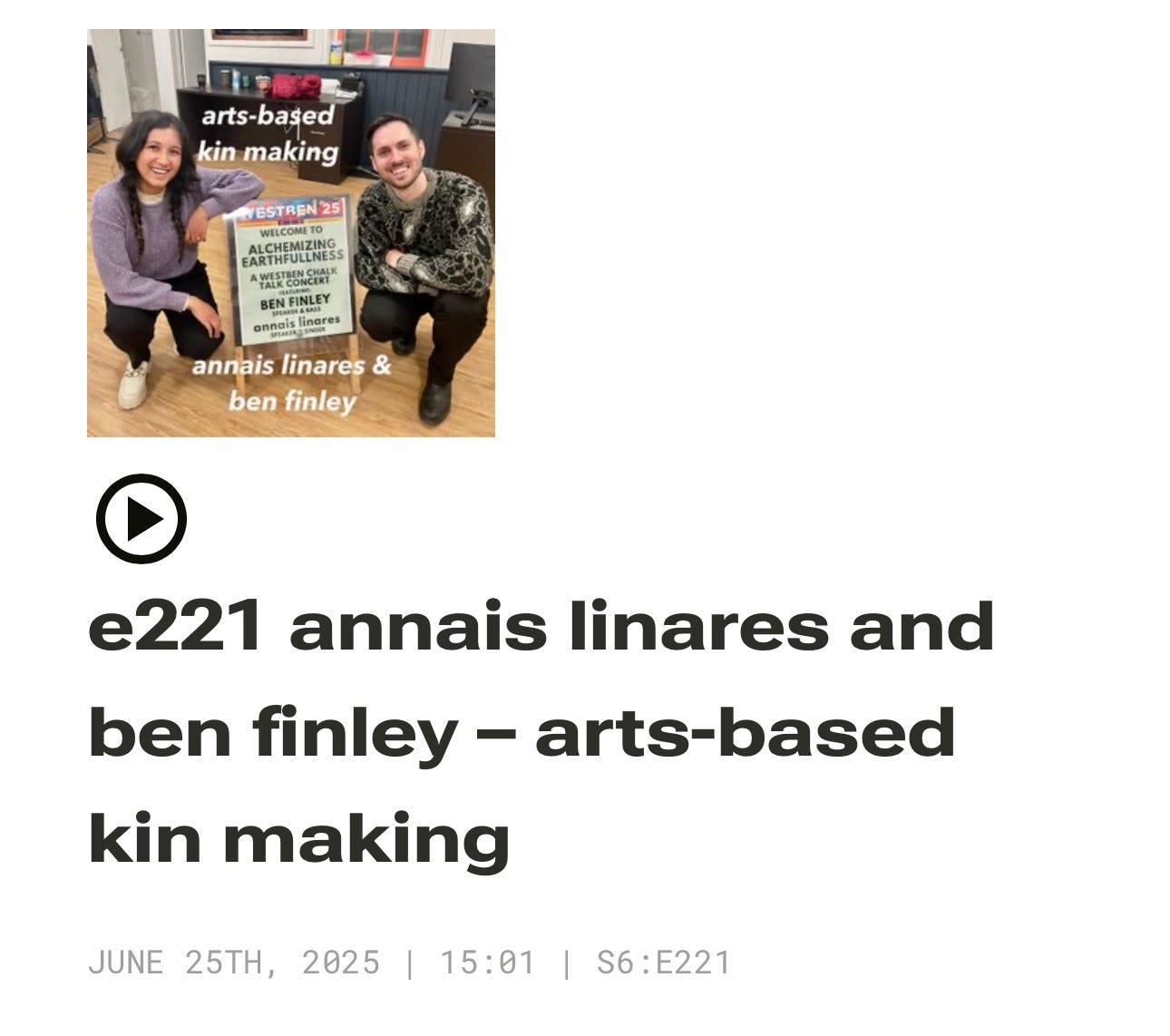
People maybe are used to being bombarded at this point with the news of what’s happening. And that’s the reality. And we need to face that. I think alongside that, we need to make moments of grounding, of rootedness and remembering our real belonging to this earth. Because without that, we don’t quite have the energy. I think we’re really zapped from stress or from what we’re hearing. It is oppressive to hear what’s happening and to experience it for those of us who are experiencing that and have been. I guess for me, that’s really what draws me to arts-based kin making is that we have to find ways to reconnect. And that’s inevitably going to shift, in my opinion, how we then act in the world and that kind of transformation is deeply important in times of crises.
This is annais linares speaking from my conversation with annais and her partner Ben Finley from e221 annais linares and ben finley – arts-based kin making on November 9, 2024 on the traditional territory of the Michi Saagiig Anishinaabeg nation near what is now known as Campbellford, Ontario.
Annais and Ben talked to me about their creation and performance of Alchemizing Earthfullness a jazz composition that explores self-rootedness, community connectedness and earth intimacy.
I love the vitality and calm in annais’ voice as she invites us to create moments of grounding, of rootedness and remembering our real belonging to this earth and to consider how arts-based kin making can help us reconnect and transform the world.
J’aime la vitalité et le calme dans la voix d’annais lorsqu’elle nous invite à créer des moments d’ancrage, d’enracinement et à nous souvenir de notre véritable appartenance à cette terre, ainsi qu’à réfléchir à la manière dont la création artistique peut nous aider à renouer avec le monde et à le transformer.
11
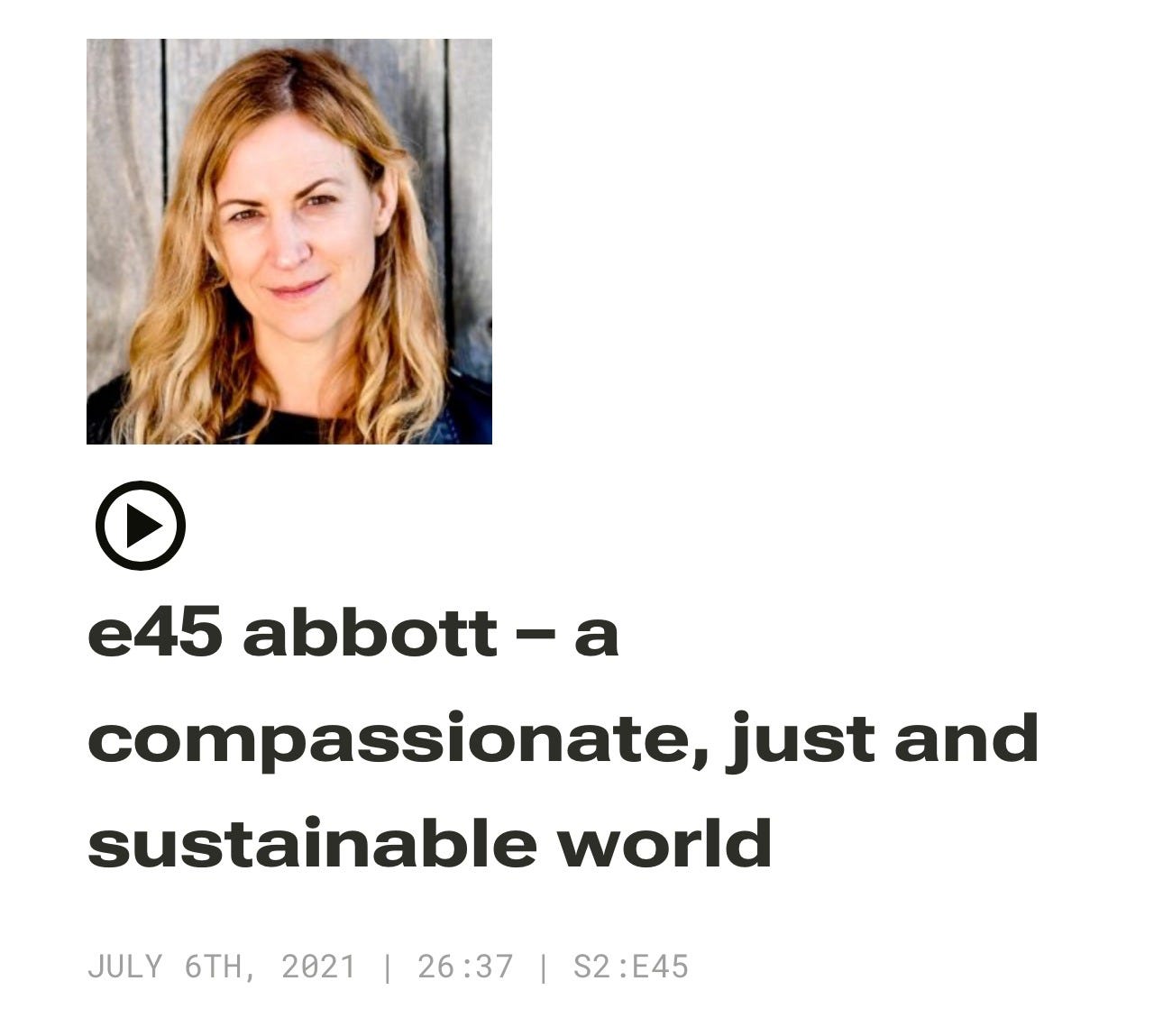
The notion of reality and the way we grasp reality as humans is so deeply subjective, but it’s also socially constructed, and so, as a filmmaker - and this is relevant because I’m also a Zen Buddhist - from both those perspectives, I try to explore what we perceive as reality to untangle and figure out in what ways are we being deluded? And in what ways do we have clear vision? And obviously the more clear vision we can have, the better actions we take to ensure a more compassionate, just and sustainable livable world. I’m all for untangling the delusion while admitting wholeheartedly that to untangle it fully is impossible.
An excerpt from e45 abbott – a compassionate, just and sustainable world. Jennifer Abbott is a Sundance and Genie award-winning film director, writer, editor, producer and sound designer who specializes in social justice and environmental documentaries. We spoke by zoom on May 6, 2021 from her home in British Columbia.
Jennifer is the co-director, with Mark Achbar, and editor of The Corporation (2003), the top grossing and most awarded documentary in Canadian history and also the director, writer, editor, sound designer and co-producer of The Magnitude of all Things (2020) a cinematic exploration of the emotional and psychological dimensions of climate change that draws parallels between experiences of personal and planetary grief.
I’m uplifted by Jennifer’s invitation to come to terms with our delusions and to identify a clear vision and better actions to ensure a more compassionate, just and sustainable livable world.
Je suis encouragé par l’invitation de Jennifer à accepter nos illusions et à définir une vision claire et de meilleures actions pour garantir un monde plus compatissant, plus juste et plus durable.
12
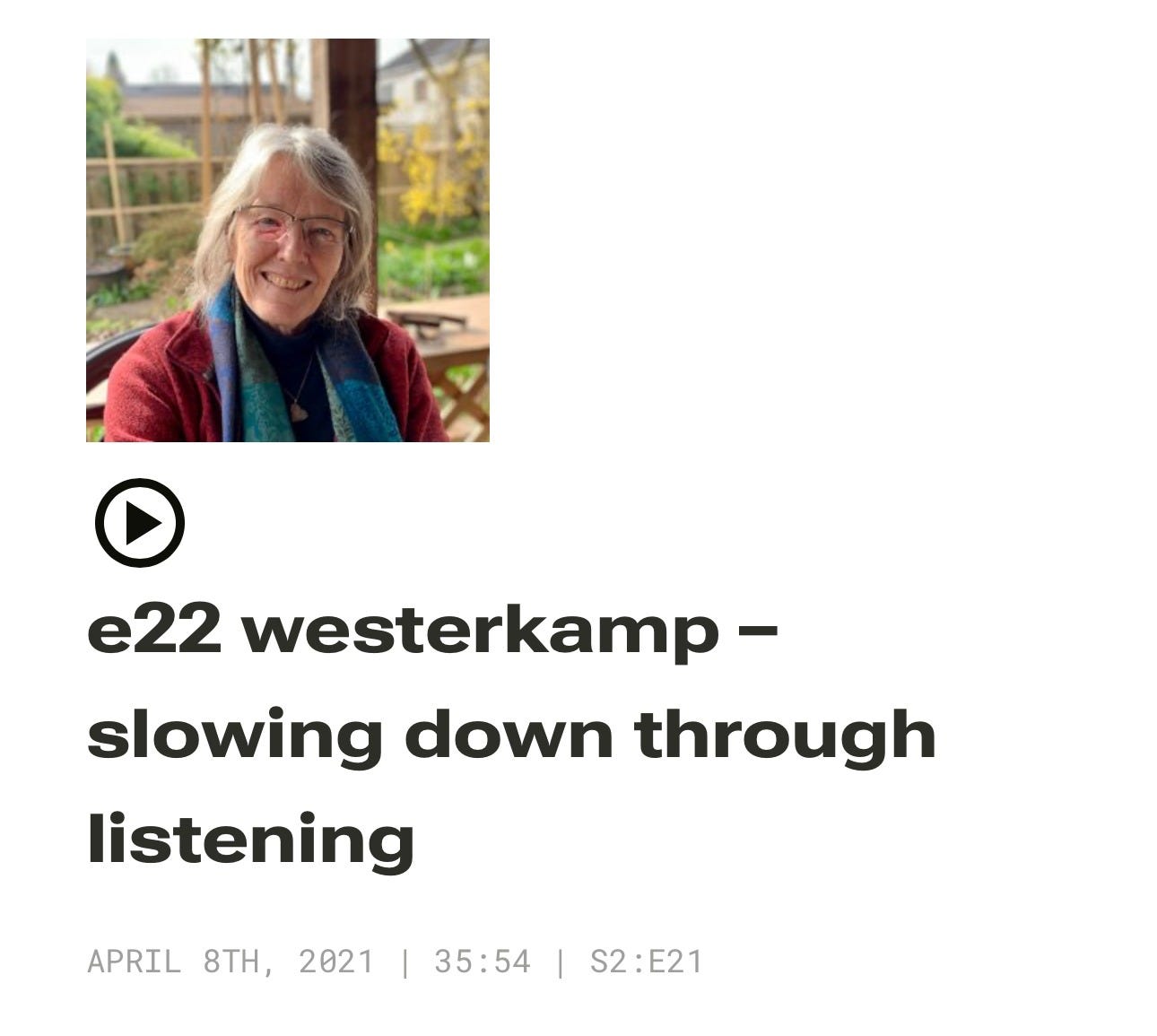
We need to allow for time to pass without any action, without any solutions and to just experience it. I think that a slowdown is an absolute - if there is any chance to survive - that kind of slowing down through listening and meditation and through not doing so much. I think there’s some hope in that.
The final excerpt of this set of 12 is from e22 westerkamp – slowing down through listening, my conversation with composer Hildegard Westerkamp recorded on March 31, 2021 in the backyard of Hildi’s home in Vancouver, on the ancestral lands of the Coast Salish peoples - the Squamish (Sḵwx̱wú7mesh), Tsleil-Waututh (Stó:lō and Səl̓ílwətaʔ/Selilwitulh), and Musqueam (xʷməθkʷəy̓əm) Nations.
Hildi and I spoke about the art of soundwalking and how to approach the climate emergency through listening. Every time I hear Hildi’s words, I’m uplifted by her suggestion that hope can emerge from slowing down, doing less and listening. How can something as elusive as hope emerge simply from slowing down, doing less and listening?
On that good note, bonne année 2026.
Thanks for your presence and take care.
Aurevoir.